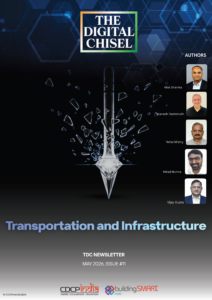
The Digital Chisel – May 2026 (Issue #11) explores the transformative role of Building Information Modeling (BIM) in transportation and infrastructure development, demonstrating how digital workflows, standardized information management, and openBIM principles are enabling India to build faster, smarter, and more resilient infrastructure. Centered around the theme “Transportation and Infrastructure,” this edition highlights how roads, railways, metros, bridges, and multimodal networks are evolving through data-driven collaboration, digital governance, and lifecycle-focused asset management to support the vision of Viksit Bharat 2047.
The newsletter features expert insights from industry leaders on how BIM has become the digital backbone of transportation infrastructure by integrating design, construction, operations, and maintenance into a single source of truth. It explores the adoption of Connected Common Data Environments (CCDEs), ISO 19650, Common Data Environments (CDEs), 4D scheduling, 5D cost management, Digital Twins, and open standards to improve coordination, reduce project risks, strengthen governance, and enhance long-term asset performance. The edition also showcases practical applications of BIM in riverfront developments, urban street design, and bridge engineering, demonstrating how technologies such as automation, simulation, augmented reality (AR), and intelligent modeling improve design accuracy, stakeholder collaboration, and construction efficiency.
In addition to thought leadership, this issue presents a comprehensive roundup of global and Indian digital construction developments, including updates to ISO 19650, advances in AI-powered BIM, Digital Twins, Information Management, Common Data Environments, and national infrastructure initiatives. It also highlights key industry events, policy developments, and emerging digital technologies that are shaping the future of transportation, smart infrastructure, and information-driven project delivery across the AECO sector.
By combining practical implementation strategies, international best practices, and emerging digital innovations, this edition serves as a valuable resource for professionals seeking to strengthen digital infrastructure delivery, improve information governance, accelerate BIM adoption, and contribute to a more connected, efficient, and sustainable transportation ecosystem.