

The Digital Chisel – Bharat’s Arc: 1947–2047 (Special Independence Day Edition) presents a compelling narrative of India’s transformation from a newly independent nation to an emerging global leader in infrastructure, technology, and digital innovation. Released to commemorate India’s 78th Independence Day, this special edition traces the country’s remarkable journey through key phases of nation-building—from the era of foundational infrastructure envisioned as the “Temples of Modern India” to the emergence of a digitally connected, sustainable, and intelligent built environment. Rather than simply documenting milestones, the publication explores how infrastructure, policy, engineering excellence, and digital transformation have collectively shaped the nation’s progress and laid the foundation for Viksit Bharat 2047. The edition examines India’s evolution across four defining eras: the post-independence focus on industrialization, public infrastructure, and institution building; the economic liberalization period that accelerated private sector participation; the post-2014 infrastructure revolution driven by large-scale connectivity initiatives; and the transition toward Industry 4.0, smart urbanism, and digitally enabled infrastructure. It highlights transformative developments including highways, railways, metros, airports, logistics corridors, smart cities, Digital Infrastructure Lifecycle Management, Building Information Modeling (BIM), open standards, Digital Twins, AI, IoT, and integrated project management, demonstrating how technology is reshaping the planning, delivery, and lifecycle management of India’s built environment. Beyond infrastructure development, the publication emphasizes that India’s future success depends on moving from building physical assets to creating cognitive, data-driven infrastructure ecosystems. It advocates for sustainable engineering, intelligent information management, digital governance, workforce capability development, and collaborative innovation supported by organizations such as CDCPIndia and buildingSMART India. The special edition concludes by envisioning India 2047 as a globally recognized leader in smart infrastructure, where artificial intelligence, connected digital technologies, open standards, and skilled professionals work together to create resilient, sustainable, and future-ready cities and infrastructure that deliver long-term societal value.

Education & Industry Enablement
The Digital Chisel – August 2026 (Issue #14) explores the vital connection between education, industry, and digital capability development in shaping the future of India’s Architecture, Engineering, Construction, and Operations (AECO) sector. Centered around the theme “Education & Industry Enablement,” this edition highlights that the success of digital transformation depends not on technology alone, but on developing professionals who understand information management, open standards, governance, and collaborative workflows. It emphasizes that building a future-ready workforce requires stronger partnerships between academia, industry, and professional institutions to equip engineers with the knowledge and competencies needed for a rapidly evolving digital construction landscape. The newsletter features expert insights on addressing the industry’s evolving BIM competency gap by shifting the focus from software proficiency to methodology-first learning. It examines the need for competency-based education founded on openBIM principles, ISO 19650, Industry Foundation Classes (IFC), Common Data Environments (CDEs), and structured information management, ensuring professionals can effectively manage information throughout the entire asset lifecycle. The edition also explores the importance of continuous professional development, internationally recognized certification pathways, Digital Construction Management, AI-enabled workflows, and interdisciplinary collaboration, reinforcing that digital capability is built through governance, process discipline, and real-world project experience rather than technology adoption alone. Beyond technical competencies, this issue advocates for a stronger integration between academia and industry through curriculum modernization, collaborative research, live project exposure, practitioner-led education, and lifelong learning initiatives. It emphasizes that future engineers must develop skills in information governance, digital collaboration, AI literacy, process integration, and decision-making, enabling them to deliver resilient, sustainable, and data-driven infrastructure projects. By fostering ecosystem-wide collaboration among educational institutions, industry bodies, project owners, and professional organizations, the edition outlines a roadmap for creating a highly skilled workforce capable of supporting India’s digital infrastructure ambitions. By combining thought leadership, educational strategies, competency frameworks, and industry best practices, this edition serves as a valuable resource for educators, students, professionals, policymakers, and organizations seeking to strengthen digital skills, promote standardized information management, and accelerate the adoption of intelligent, interoperable, and future-ready construction practices across the AECO industry.
Shaping India’s Digital Workforce
The Digital Chisel – July 2026 (Issue #13) explores the critical role of developing a future-ready digital workforce to support India’s rapidly evolving Architecture, Engineering, Construction, and Operations (AECO) industry. Centered around the theme “Shaping India’s Digital Workforce,” this edition emphasizes that digital transformation is driven not only by technology, but by professionals who can create, manage, govern, and preserve trusted information throughout the asset lifecycle. It highlights the importance of building digital capability, adopting open standards, and fostering collaborative information management to realize the vision of Viksit Bharat 2047. The newsletter features expert perspectives on strengthening India’s digital construction workforce through professional certification, information management, openBIM methodologies, and lifecycle-focused digital delivery. It explores the evolving role of Digital Managers, who bridge people, processes, and technology to guide successful digital transformation across organizations. The edition also highlights the importance of internationally recognized frameworks such as ISO 19650, openBIM, and the buildingSMART International Professional Certification Program, demonstrating how standardized methodologies, interoperability, and structured governance enable consistent collaboration, reliable information exchange, and scalable project delivery across the built environment. Beyond technical competencies, this issue examines India’s growing digital skills gap and the need to align education, industry, and continuous professional development with real-world project requirements. It emphasizes that the future workforce must move beyond software proficiency to develop capabilities in information governance, data quality, digital collaboration, AI readiness, lifecycle thinking, and trusted decision-making. The edition concludes by reinforcing that while technologies will continue to evolve, human capability remains the true foundation of sustainable digital transformation, enabling organizations to preserve knowledge, improve infrastructure outcomes, and create long-term value for future generations.
The Digital Runway: Architecting India’s Aviation Renaissance
The Digital Chisel – June 2026 (Issue #12) explores how digital transformation is reshaping India’s aviation infrastructure, positioning airports as intelligent, connected ecosystems rather than conventional transport facilities. Centered around the theme “The Digital Runway: Architecting India’s Aviation Renaissance,” this edition examines how Building Information Modeling (BIM), Digital Twins, Common Data Environments (CDEs), and open information standards are enabling the planning, delivery, and long-term operation of next-generation airports. It highlights the critical role of structured information management in supporting India’s rapidly expanding aviation sector and advancing the vision of Viksit Bharat 2047. The newsletter features expert insights on how digital technologies are transforming airport development from design through operations. It showcases the implementation of BIM, Common Data Environments (CDEs), Digital Twins, GIS integration, Reality Capture, 4D/5D BIM, and Computerized Maintenance Management Systems (CMMS) in large-scale projects such as Noida International Airport, demonstrating how connected digital workflows improve collaboration, streamline project delivery, and enhance lifecycle asset management. The edition also highlights the growing importance of openBIM, IFC, COBie, decentralized trust, Digital Public Infrastructure, and interoperable information frameworks to ensure data sovereignty, operational resilience, and vendor-neutral information exchange across complex aviation ecosystems. Beyond digital delivery, this issue explores the future of AI-driven airport operations, where Digital Twins, IoT sensors, predictive analytics, and trusted digital identity enable real-time decision-making, optimize passenger flow, improve operational efficiency, and increase terminal capacity without physical expansion. It also highlights sustainable aviation initiatives, including water-positive airport strategies, rainwater harvesting, wastewater reuse, and resource-efficient infrastructure, demonstrating how digital innovation and environmental stewardship are converging to create resilient, future-ready airports. By combining practical implementation strategies, emerging technologies, sustainability initiatives, and global best practices, this edition serves as a valuable resource for professionals seeking to accelerate digital transformation, strengthen information governance, improve airport operations, and build intelligent, connected, and sustainable aviation infrastructure for the future.
Transportation and Infrastructure
The Digital Chisel – May 2026 (Issue #11) explores the transformative role of Building Information Modeling (BIM) in transportation and infrastructure development, demonstrating how digital workflows, standardized information management, and openBIM principles are enabling India to build faster, smarter, and more resilient infrastructure. Centered around the theme “Transportation and Infrastructure,” this edition highlights how roads, railways, metros, bridges, and multimodal networks are evolving through data-driven collaboration, digital governance, and lifecycle-focused asset management to support the vision of Viksit Bharat 2047. The newsletter features expert insights from industry leaders on how BIM has become the digital backbone of transportation infrastructure by integrating design, construction, operations, and maintenance into a single source of truth. It explores the adoption of Connected Common Data Environments (CCDEs), ISO 19650, Common Data Environments (CDEs), 4D scheduling, 5D cost management, Digital Twins, and open standards to improve coordination, reduce project risks, strengthen governance, and enhance long-term asset performance. The edition also showcases practical applications of BIM in riverfront developments, urban street design, and bridge engineering, demonstrating how technologies such as automation, simulation, augmented reality (AR), and intelligent modeling improve design accuracy, stakeholder collaboration, and construction efficiency. In addition to thought leadership, this issue presents a comprehensive roundup of global and Indian digital construction developments, including updates to ISO 19650, advances in AI-powered BIM, Digital Twins, Information Management, Common Data Environments, and national infrastructure initiatives. It also highlights key industry events, policy developments, and emerging digital technologies that are shaping the future of transportation, smart infrastructure, and information-driven project delivery across the AECO sector. By combining practical implementation strategies, international best practices, and emerging digital innovations, this edition serves as a valuable resource for professionals seeking to strengthen digital infrastructure delivery, improve information governance, accelerate BIM adoption, and contribute to a more connected, efficient, and sustainable transportation ecosystem.
BIM for Residential Speed
The Digital Chisel – April 2026 (Issue #10) explores how Building Information Modeling (BIM) is accelerating residential construction and enabling India to meet the growing demand for high-quality, sustainable housing. Centered around the theme “BIM for Residential Speed,” this edition examines how digital construction, modular building methods, standardized information management, and openBIM principles are transforming residential project delivery from design through operations. It highlights the role of BIM as a strategic enabler for delivering faster, more predictable, and data-driven housing projects aligned with India’s vision of a $1 trillion residential market by 2030. The newsletter features expert insights from leading industry professionals on how BIM is evolving beyond design coordination into a connected information ecosystem that supports the entire building lifecycle. It showcases how parametric modeling, prefabrication, Common Data Environments (CDEs), ISO 19650, Level of Information Need (LOIN), 4D scheduling, and 5D cost management improve collaboration, reduce rework, optimize construction sequencing, and enhance project certainty. The edition also explores how BIM-driven digital configurators are transforming customer engagement in residential developments, while digital inventory, material passports, Digital Twins, and IoT technologies are enabling circular construction, lifecycle asset management, and improved resource efficiency through standardized information governance. In addition to thought leadership, this issue presents a comprehensive roundup of national and international AECO developments, including highlights from the buildingSMART International Summit Porto 2026, major BIM conferences, sustainability initiatives, structural engineering forums, and digital construction events. It also features upcoming CDCPIndia | buildingSMART India webinars covering interoperability, Scan-to-BIM for heritage conservation, blockchain in real estate, and virtual construction, reinforcing the industry’s continued focus on open standards, innovation, and digital transformation. By combining practical implementation strategies, global best practices, and emerging technologies, this edition serves as a valuable resource for professionals seeking to leverage BIM for faster residential delivery, strengthen information management, improve sustainability, and advance the digital transformation of India’s built environment.

Evolution & Future Outlook
The Digital Chisel – March 2026 (Issue #9) explores the evolution and future outlook of digital construction, highlighting how Building Information Modeling (BIM), Digital Twins, Artificial Intelligence (AI), and open standards are reshaping the Architecture, Engineering, Construction, and Operations (AECO) industry. This edition examines the industry’s transition from fragmented, document-centric processes to integrated, data-driven ecosystems that improve collaboration, project certainty, operational efficiency, and long-term asset performance. It reinforces that digital transformation is no longer an option but a strategic necessity for delivering resilient and future-ready infrastructure aligned with India’s Viksit Bharat 2047 vision. The newsletter features expert insights on the current state and future direction of digital construction, including the growing adoption of BIM+, Common Data Environments (CDEs), Digital Twins, Project Management Systems, and Artificial Intelligence to streamline project delivery and optimize decision-making. It also highlights the evolution of IFC 5, emphasizing the importance of openBIM standards, interoperability, and vendor-neutral information exchange for enabling scalable digital ecosystems. The edition further explores how Digital Twins are transforming asset management through predictive maintenance, real-time monitoring, and lifecycle intelligence, while showcasing the broader impact of AI, cloud platforms, LiDAR, automation, and integrated digital workflows in driving productivity, sustainability, and operational excellence across construction projects. In addition to thought leadership, this issue presents a comprehensive roundup of national and international AECO developments, covering major BIM, digital construction, infrastructure, geospatial, AI, sustainability, and industry events. It also highlights upcoming initiatives such as the buildingSMART International Summit Porto 2026, along with advancements in Digital Twins, IFC adoption, 4D BIM, predictive analytics, and lean construction practices that are shaping the future of the global built environment. By bringing together expert perspectives, emerging technologies, open standards, and industry developments, this edition serves as a valuable resource for professionals seeking to embrace digital innovation, strengthen information management, improve project delivery, and prepare for the next generation of intelligent, connected, and sustainable infrastructure.

Engineering Tech: AI, VR, AR
The Digital Chisel – February 2026 (Issue #8) explores how emerging technologies such as Artificial Intelligence (AI), Virtual Reality (VR), and Augmented Reality (AR) are transforming the Architecture, Engineering, Construction, and Operations (AECO) industry by enabling smarter decision-making, safer project delivery, and more sustainable infrastructure. Centered on the theme “Emerging Tech: AI, VR, AR,” this edition demonstrates how these technologies are moving beyond innovation to become practical tools for improving design, construction, collaboration, and lifecycle asset management across the built environment. The newsletter features expert perspectives on the real-world applications of AI, immersive technologies, and digital workflows. It highlights how AI-powered BIM is improving construction site safety through immersive simulations and predictive risk analysis, while VR is transforming stakeholder engagement with collaborative virtual walkthroughs that enable design validation before construction begins. The edition also explores how AR enhances on-site execution by overlaying BIM models onto physical environments for accurate installation, progress monitoring, and quality assurance. In addition, it emphasizes the importance of open standards, BIM data round-tripping, IFC, and BCF in ensuring that information remains connected, interoperable, and accessible throughout the project lifecycle. The issue further examines how model-driven workflows, life cycle thinking, and AI-enabled analytics support sustainable decision-making, carbon reduction, and resilient infrastructure development. Alongside expert thought leadership, this issue presents a curated overview of national and international AECO developments, featuring technology festivals, digital infrastructure initiatives, BIM and Digital Twin adoption, GIS integration, sustainability programs, and global policy discussions that are shaping the future of digital construction. These updates reinforce the growing role of intelligent technologies in driving innovation, collaboration, and digital transformation across the industry. By combining practical insights, emerging technologies, and global industry developments, this edition serves as a valuable resource for professionals seeking to leverage AI, VR, AR, and digital twins to improve project performance, strengthen collaboration, enhance sustainability, and accelerate the digital transformation of the AECO sector.

Data-Driven AECO
The Digital Chisel – January 2026 (Issue #7) explores how data is transforming the future of the Architecture, Engineering, Construction, and Operations (AECO) industry by shifting the focus from document-based workflows to intelligent, standardized, and data-driven decision-making. Centered around the theme “Data-Driven AECO,” this edition examines how structured information, open standards, artificial intelligence, and business intelligence are enabling project teams to improve collaboration, project certainty, operational efficiency, and lifecycle asset management. The newsletter features expert insights from global and industry leaders on the importance of placing people at the center of digital transformation, emphasizing that technologies such as AI, Digital Twins, and predictive analytics deliver value only when supported by strong data governance, standardized information management, and collaborative workflows. It highlights the significance of ISO 19650, Industry Foundation Classes (IFC), and Information Delivery Specifications (IDS) in creating interoperable, machine-readable data that improves quality assurance, automation, and regulatory compliance. The edition also explores how integrating BIM with Power BI transforms project data into actionable dashboards, while AI-powered analytics enhance schedule optimization, risk prediction, and executive decision-making throughout the project lifecycle. In addition to thought leadership, this issue provides a comprehensive roundup of national and international AECO developments, including major conferences, digital construction summits, smart infrastructure initiatives, sustainability forums, BIM and openBIM advancements, AI applications, and government-led infrastructure programs. These updates showcase the latest innovations shaping digital construction, intelligent asset management, and India’s journey toward a Viksit Bharat 2047 through data-driven infrastructure delivery. By combining practical guidance, international best practices, and emerging digital technologies, this edition serves as a valuable resource for professionals seeking to harness the power of data, strengthen information governance, improve project performance, and accelerate the digital transformation of the global AECO industry.
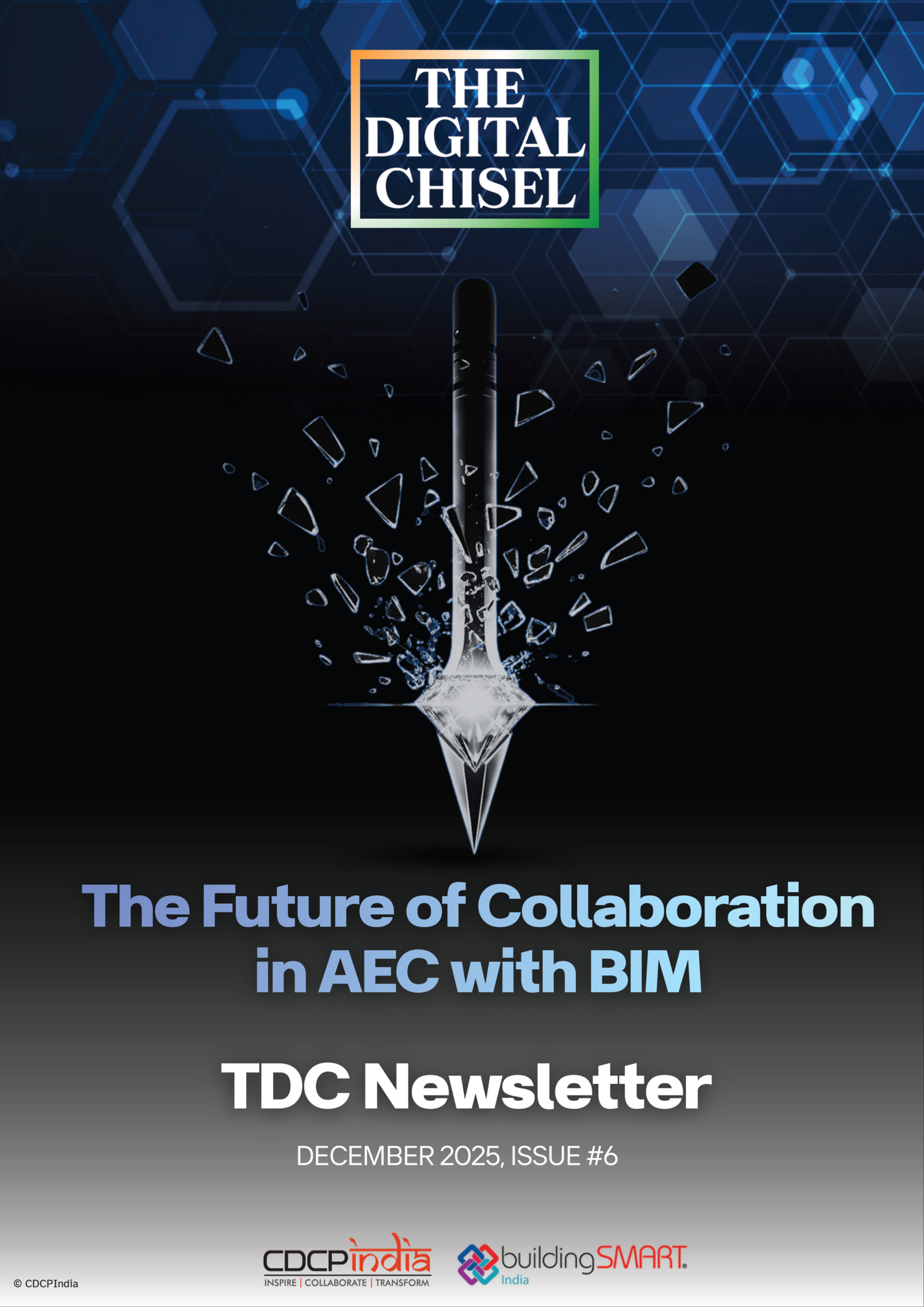
The Future of Collaboration in AEC with BIM
The Digital Chisel – December 2025 (Issue #6) explores how collaboration is redefining the future of the Architecture, Engineering, Construction, and Operations (AECO) industry through Building Information Modelling (BIM). Centered around the theme “The Future of Collaboration in AEC with BIM,” this edition highlights how cloud-based platforms, Common Data Environments (CDEs), openBIM standards, and digital workflows are enabling project teams to work from a single source of truth, improving transparency, coordination, and lifecycle efficiency. The newsletter features expert insights from leading industry professionals on advanced BIM-enabled collaboration, effective implementation of Common Data Environments, BIM standardization in India through ISO 19650 and openBIM principles, and the practical opportunities and challenges associated with digital transformation. It emphasizes the importance of interoperability, standardized information management, and collaborative project delivery in supporting India’s vision for a digitally empowered Viksit Bharat 2047. Alongside thought leadership articles, the edition provides a comprehensive roundup of national and international developments across the AECO sector, covering infrastructure projects, BIM initiatives, industry conferences, sustainability, digital twins, AI-driven construction technologies, smart cities, quality standards, and policy updates. Together, these insights offer professionals a valuable perspective on emerging trends shaping the future of digital construction worldwide. Readers will gain practical knowledge on collaborative BIM practices, industry standardization, digital innovation, and the evolving technologies driving more efficient, sustainable, and connected construction ecosystems.